
Nozzle Design:
Liquid Rocketry Club
Why?
I was assigned to create a proposal design for a sub-team that I wanted to become a part of. I chose to design a nozzle based on a sustainable design. I chose the propellant and found parametric equations to determine the dimensions of the nozzle.
How?
To create this model, I had to first choose the propellant of the rocket. Based on research(Clark,2018), I decided that H202 and RP-1 would be a great liquid propellant for this project. It is stable, economical, and practical. After determining which rocket propellant I will be using, I decided to use equations(Sutton, 2017), to determine the unknown parametric variables. The parametric properties need for the design are Chamber Pressure, Chamber temperature, Thrust, Altitude, Coefficient of Heats, and Gas Constant.
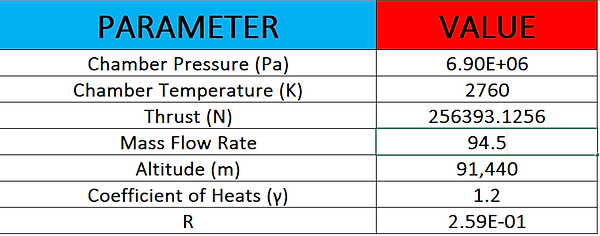
The known parametric properties were combustion temperature, combustion pressure, altitude(Karman line), gas constant, and thrust. These properties were found from the table below.
However, there are a few assumptions that I have implemented. The is an isentropic process, thrust is around 256kN(Black Arrow), Isp shifting is 276(Black Arrow). (Wade,2002).
Subsequently, I determined the other unknown properties characteristic velocity and mass flow rate using equation from the Rocket Propulsion Elements textbook. 𝐶=𝐼𝑠 𝑔o. Thus C = 2707.56. M flow rate = T/C. Therefore, the mass flow rate is equal to 94.5m/s. After figuring out these parametric values, I inputted my results to an excel sheet that is co-joined to MATLAB code.
After inserting these parametric values, I used a method of characterization MATLAB code to find the dimensions of the nozzle.

Results
I was able to attain a graph that illustrated the dimensions of the nozzle. These properties were determined using a MATLAB code and the results are shown below.

